
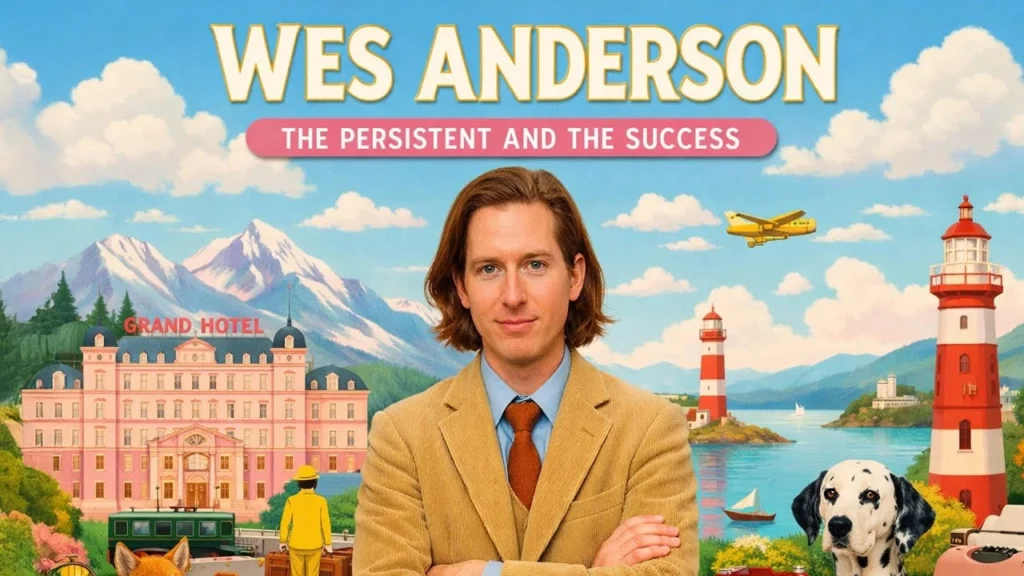
Wes Anderson: The Architect of Worlds | A Deep Sleep Story on Persistence & Cinematic Vision
Step into the perfectly symmetrical, pastel-hued world of one of cinema’s most distinctive voices with “Wes Anderson: The Persistent and The Success.”
This 1-hour and 34-minute immersive narrative is more than just a biography; it is a serene journey through the creative mind of Wes Anderson. Designed for deep sleep and relaxation, this story follows Wes from his childhood bedroom in Houston to the grand stages of the Academy Awards, exploring how a singular, uncompromising vision can transform the landscape of modern film.
The Story of an Unwavering Vision
The narrative begins in 1979, where a young Wesley Wales Anderson sits cross-legged on his bedroom carpet, arranging objects with the precision of a museum curator [00:18]. From these early days of creating dioramas to escape the chaos of his parents’ divorce [00:56], Wes developed a lens that saw the world as a series of managed facades—a philosophy that would later define masterpieces like The Grand Budapest Hotel and The Royal Tenenbaums.
Why This Sleep Story is a Must-Listen:
-
From Failure to Cult Classic: Follow the grueling four-year journey to make Bottle Rocket [13:08], a film that initially failed at the box office but announced the arrival of a genuine auteur [31:48].
-
The Bill Murray Connection: Discover how the casting of Bill Murray in Rushmore [41:37] created one of the most consequential partnerships in film history, bridging the gap between quirky comedy and profound melancholy.
-
The Mastery of Style: Learn about the evolution of “Wes-style”—from the lateral tracking shots and symmetrical compositions to the meticulous color palettes that make every frame a piece of art [43:56].
-
A Lesson in Persistence: This is a story for every dreamer who has been told their vision is “too quirky” or “unmarketable.” It is a testament to the power of sticking to your guns until the world learns to see things your way [01:32:08].
Key Chapters in the Narrative:
-
[00:00] The Boy Who Built Worlds: Childhood in Houston and the foundational influence of the French New Wave.
-
[12:06] The Bottle Rocket Miracle: The improbable breakthrough from a 13-minute short film to a Hollywood feature.
-
[35:50] Max Fischer & Rushmore: Exploring adolescent ambition and the discovery of a true visual language.
-
[51:28] The Royal Tenenbaums: Consolidating a style and creating an iconic portrait of family dysfunction.
-
[01:13:49] Evolution & Mastery: From the stop-motion magic of Fantastic Mr. Fox to the global triumph of The Grand Budapest Hotel.
Perfect For:
-
Cinephiles & Art Lovers: Those who want to dive deep into the technical and emotional layers of Anderson’s filmography.
-
Creatives Seeking Inspiration: A soothing reminder that persistence is the ultimate key to success.
-
Sleep & Meditation: The calm, rhythmic narration provides a sanctuary for the mind, helping you drift off while absorbing a fascinating life story.
“He hadn’t succeeded by giving audiences what they thought they wanted. He had succeeded by creating something so complete and so genuinely his own that audiences learned to want what he was offering” [01:32:39].
Watch the official video here: Wes Anderson – The Persistent and The Success
From the video description…